

First dietitian appointment in Poland: what to expect
What to expect at your first dietitian appointment in Poland: referral, what to bring, how the visit works, costs, and English-speaking help in Wrocław.
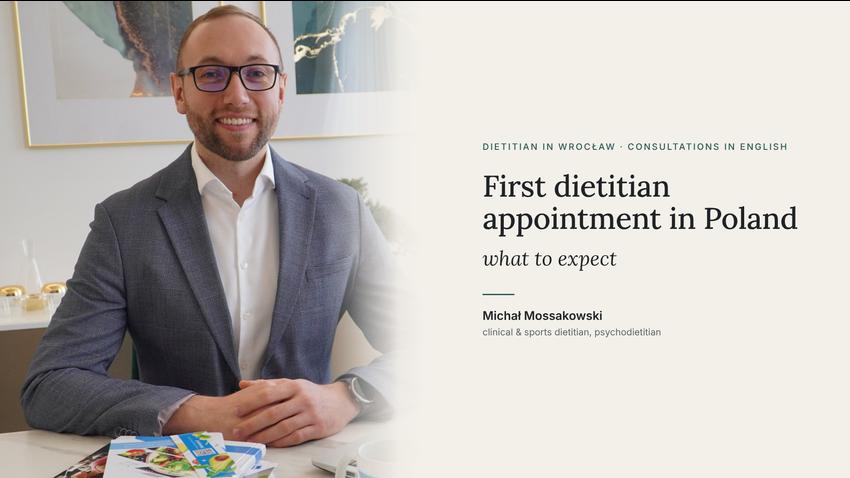
Booking a first appointment with a dietitian in a new country raises more questions than the visit itself: whether you need a referral from a doctor, who is actually allowed to call themselves a dietitian, what will be measured, and whether anyone will explain it all in a language you understand. In Poland the answers differ from what many people expect from the United Kingdom, Germany or the United States, and a little preparation makes the first meeting far more useful.
This article describes how a first visit usually works in a private practice in Poland, what to bring, what happens afterwards, and how costs and public healthcare fit into the picture. I write it as a dietitian, psychodietitian and sports dietitian who sees patients in Wrocław and Siechnice, in person and online, and who regularly works with clients in English. It is general information and does not replace medical advice.
Do you need a referral to see a dietitian in Poland?
In a private practice you do not. You book directly, you pay for the visit yourself and no doctor has to approve it, which is the most common route for people who want help with weight, training, digestive complaints or a long-standing condition such as insulin resistance or Hashimoto's disease. The public system works differently: free consultations with a dietitian are offered only within coordinated primary care in selected GP clinics, they depend on your diagnosis and on a doctor's decision, and they are not something you can simply book for yourself. The National Health Fund (NFZ) also runs a free online portal with ready-made menus, which is a reasonable general starting point but is not an individual plan built around your health history, your training and your daily routine.
Who can call themselves a dietitian, and how do you choose one?
Poland does not yet have a dedicated law on the dietitian profession. A bill on the profession and its professional self-government was submitted to the Sejm in 2026 and is still being considered, so for now the title says less about training than it does in some other countries. In practice this means it is worth asking a few ordinary questions before you book: what the person studied, how much experience they have with your type of problem, and whether they cooperate with your doctor when that is needed. If language matters to you, ask whether the consultation, the meal plan and the recipes will all be in English, because some practices offer only a conversation in English and a plan in Polish. A good dietitian will answer these questions without hesitation.
What happens during the first appointment?
Structured nutrition care follows a similar logic everywhere. The Academy of Nutrition and Dietetics describes it as four connected steps: assessment, diagnosis of the nutrition problem, intervention, and monitoring with evaluation, and this framework is used by dietitians internationally. In my practice the first visit takes 40 to 60 minutes and covers the first two steps and the start of the third. It begins with the assessment: a body composition measurement, a detailed conversation about your health history, medications, previous diets, sleep, stress, training, work schedule and the way you really eat on an ordinary weekday, and a look at any blood tests you bring.
The part that matters most, and the one most often skipped in shorter visits, is naming the problem correctly. Fat loss that has stalled despite a healthy diet may come from too little protein, from irregular meals, from poor recovery after training or from a hormonal condition that needs a doctor, and the plan looks completely different in each case. Only then do we move to the intervention. After the visit I prepare an individual plan for 21 days with menus, recipes, shopping lists, a booklet of product substitutes and practical tasks, and at follow-up visits we check what worked in real life and adjust. If you are not used to Polish shops, I add the Polish name of a product next to the English one, so the plan can actually be shopped for. The page describing how my first visit works is in Polish, but the structure is the same: seethe first visit pagefor the details.
What should you bring to your first appointment?
Bring any recent blood test results, even if they come from another country. Units and reference ranges can differ between laboratories and countries (for example mg/dL and mmol/L), so the original report is more useful than a summary. A list of medications and supplements, a short note on diagnoses and previous treatments and, if you train, a rough description of your weekly schedule are equally helpful. You do not need a perfect food diary: a few typical days written from memory are usually enough to start. If your partner does not speak Polish, they can normally join the visit and follow the discussion in English.
How often will you meet, and what comes after the first visit?
One plan covers about three weeks, and a follow-up visit of around half an hour then checks your body composition, goes through what was realistic and what was not, and produces the next plan. People who prefer a steady rhythm often choose a package of three or six months, but a single consultation is a perfectly valid way to start. Nutrition care is mostly measurement and adjustment, and one appointment rarely solves a long-standing problem, so it is worth deciding in advance how much support you want.
How much does a dietitian cost in Poland, and will insurance cover it?
Private consultations are paid out of pocket, and prices vary between cities and practices. In my practice the first consultation with an individual 21-day plan costs 490 PLN and a follow-up with a new plan costs 290 PLN, with the same prices online. Visits in a private practice are not reimbursed by the National Health Fund. Some private health packages, for example those offered by employers, may include a dietitian consultation, so it is worth asking your provider before you book.
When is a medical consultation needed?
A dietitian does not diagnose or treat disease and does not change medication doses. Symptoms such as unexplained weight loss, blood in the stool, persistent abdominal pain or a very fast heartbeat need a doctor first. The plan should also be coordinated with your doctor if you are pregnant or breastfeeding, if you have diabetes treated with medication, a kidney or liver condition, or if you have a history of an eating disorder. Many people arrive with ongoing fatigue or a suspected thyroid problem that should be checked with laboratory tests before any dietary change, and a responsible dietitian will tell you when a medical visit should come first.
Finding an English-speaking dietitian in Wrocław and Siechnice
If you live or work around Wrocław, I see clients in English in Wrocław and Siechnice and online, with the consultation, the meal plan, the recipes and the written recommendations all in English. My clients are mostly adults between 25 and 45 who come with questions about weight, training, insulin resistance, thyroid conditions or digestive complaints, and about eating in Poland as a non-Polish speaker. You can read more about the details and the prices on theEnglish-speaking dietitian in Wrocławpage and decide whether the way I work suits you.
Frequently asked questions
Can I have a dietitian appointment online in Poland?
Yes. Many dietitians offer video consultations, and they work well if you live outside the city or have a busy schedule. In my practice online visits cost the same as in-person ones, and the materials are sent to an address in Poland.
Do I need blood tests before the first visit?
They are helpful if you have recent results, but they are not required. If you do not have any, we can decide together which tests are worth doing and discuss them with your doctor.
Will the plan include products I can buy in Poland?
Yes. The plan is built around products available in local shops, and I add the Polish name next to the English one where it helps, so that shopping in a supermarket becomes easier.
How long does the first appointment take?
The first consultation takes 40 to 60 minutes. A follow-up visit takes around 30 minutes.
Can my partner join the appointment?
Yes. This is common, especially when one person speaks only English, and it often helps both of you to follow the plan afterwards.
How do I book an appointment in English?
You can choose a date in the online booking calendar (the calendar is in Polish), send a message through the form on the English page, or write to me by e-mail or WhatsApp, and I will suggest the available dates.Book an appointment
Would you like to discuss your situation?
You can call me or write on WhatsApp at +48 796 015 510, or send a short message describing what you would like to work on. I see patients in Wrocław and Siechnice and online.Book an appointment
Read also
- English-speaking dietitian in Wrocław: consultations, packages and prices
- First visit: how it works (page in Polish)
- Price list (page in Polish)
Sources
- Academy of Nutrition and Dietetics. Nutrition Care Process overview:https://www.eatrightpro.org/practice/nutrition-care-process/ncp-overview
- Sejm of the Republic of Poland, print no. 3126 (16 July 2026). Bill on the profession of dietitian and professional self-government of dietitians:https://api.sejm.gov.pl/sejm/term10/prints/3126/3126.pdf
- Interia Biznes. Free dietitian consultation within coordinated primary care (POZ):https://biznes.interia.pl/finanse/news-nfz-ma-darmowa-usluge-bezplatna-konsultacja-u-dietetyka-nie,nId,23541700
- National Health Fund (NFZ). Diety NFZ portal:https://diety.nfz.gov.pl
Michał Mossakowski
Dietitian, psychodietitian and sports dietitian


Komentarze zostały wyłączone dla tego wpisu.